Showing posts with label Slow Food. Show all posts

Wednesday, 20 January 2010

pulled pork


Australians like to think that they are the BBQ kings and queens of the Universe. And we are. But just as we accuse Americans of being arrogant and insular, so are we about BBQ. The BBQ we know, whether it me dodgy spewpermarket snags over Heat Beads, or gohr-may seafood skewers in a Webber, the truth is BBQ is much MUCH more than that.

Pulled pork is a typical BBQ dish from Southern US, called "pulled" because it is slow cooked to the point that all the connective tissue breaks down and you can pull the pork apart by hand. It is then served in sandwiches and over rice.

In the United States, pulled pork is commonly slow-cooked by a smoking method (known as BBQ'ing), though a non-barbecue method might also be employed.


The preparation of pulled pork differs from region to region. In areas such as Tennessee, pulled pork is typically made from a mixture of the blade shoulder and arm shoulder meat and served with a tomato-based barbecue sauce. In areas such as Noth Carolina, both mixed cuts of the belly and shoulder alone are commonly used, and the pork is served with a vinegar-based sauce or with no sauce.

My pulled pork was slow cooked on the stove top for almost 7 hours. I used a 1kg chunk of pork belly roast and left the skin on.


I slow cooked it with a can of tomatoes, some capers, a fresh sliced jalapeno chilli, some sweet pickled onions (with the vinegar) and plenty of chicken stock. I used my trusty old cast iron camp oven, and had it in low heat for 6.75 hours. I then removed the skin and finely sliced it (the rubbery skin bits made a wonderful textural counterpoint to the meat and the onions) and "pulled" the roast apart with 2 forks. I actually cooked it in 2 sittings, on for 3 hours on Sunday night and then again on Monday. When I got home from work on Monday night, the hours was positively fragrant!

We ate half of it over rice with fresh cracked black pepper, and are saving the other half to use on Thursday, for a nacho topping, a la Tammi Jonas 's suggestion.

Friday, 8 May 2009

Same Time Each Year.


There's an Alan Alda film I recall, from the 80's maybe? Where he and his lover get together at the same time every year for a week-long affair. Despite both being married to other people, they meet every year to re-kindle their passion. "Same Time Next Year". This pretty much sums up my relationship with my crock pot. At the first sign of Winter, I get her out of the cupboard, and there she stays on the bench top until the first sign of Summer. It roughly corresponds to the day I first realise that open-toed shoes are no longer seasonally appropriate and the day, the following season, when I paint my toenails in anticipation.

And what better way to celebrate my loves emancipation from the back of the pot cupboard, than with Beef and Guinness Stew?

500g of the cheapest stewing steak you can get your hands on.
1 stubbie of Guinness (don't bother with the special gas canned stuff. Keep that for drinking)
a goodly squirt of Worcestershire sauce.
a goodly squirt of tomato sauce.
One small brown onion, diced.
200g frozen peas.
One carrot, chopped.

Bung the whole lot into the crock pot, and leave on low for 24 hours.

Serve with parsley mash.


Thicken leftovers with cornflour and turn into pot pies for lunch the next day.

Apart from the cooking time, this is the fastest slow food in the Nomniverse. If you plan one day in advance, you'll always have dinner waiting when you get home. I don't bother browning, searing, or any of that phaffing about. Cut meat. Cut onions. Bung in cooker. Turn on. Walk away.

Total prep time? Less than 5 mins.

And once you've scarfed the stew, clean the pot out and bung in tomorrow night's nosh. In our case, the other 500g of stewing steak, a fine sliced leek, another carrot, some organic peanut butter, some fish sauce, and some Japanese cooking vinegar, and we'll be having beef satay on rice tonight!

Thursday, 21 August 2008

Blessed are the cheesemakers...


JESUS:
They shall have the earth...
GREGORY:
What was that?
JESUS:
...for their possession. How blest are those...
MR. CHEEKY:
I don't know. I was too busy talking to Big Nose.
JESUS:
...who hunger and thirst to see...
MAN #1:
I think it was 'Blessed are the cheesemakers.'
JESUS:
...right prevail.
MRS. GREGORY:
Ahh, what's so special about the cheesemakers?
GREGORY:
Well, obviously, this is not meant to be taken literally. It refers to any manufacturers of dairy products.
Stickyfingers, at her blog, has a wonderful post up about the traditional consumption of raw milk, and its role in cheesemaking.

After years of extensive lobbying by the likes of Will Studd, Food Standards Australia and New Zealand (FSANZ) have finally announced a review of domestic dairy processing standards that currently ban the production and sale of raw milk and the cheeses made with it.

Sticky says:

This opportunity to effect change may not come again for another ten years so it is vital that anyone who would like to liberate Australian Cheesemakers make a submission to FSANZ. That's you, as an individual, even if you have nothing to do with the food industry, even if you (heaven forbid) don't eat cheese. It's about the right of the consumer to choose what they consume and the support of traditional practices such as the production of raw milk cheeses and other products to ensure that they don't die out. Please, please, please?

Now, once I got over my alarm that there might even BE people who don't eat cheese, I realised that this is a unique opportunity to actually affect policy implementation at a SOLE level. I mean, all the hype over the "safety" of GM foods, and The Nanny State still thinks we need to be protected from a most basic food source in its least adulterated form??

I am of an age where I can remember drinking milk straight from the beast at various family farms, getting up early enough to be the one that literally creamed the plug of cream out of the glass bottles of UNPASTEURISED, UNHOMOGENISED milk that had been delivered by the local milkman and his Clydesdale in the wee smalls!

The FSANZ discussion paper it is available to download here.

I urge all of you, dear readers, to cut and past the following into your email and submit it. SOLE isn't just about buying your asparagus in season, it's about supporting those producers who want wider choice and access to raw products (milk and otherwise) without Big Brother dictating to them.

This blog has Stats counters. I know where you all are. Readers who don't get on to this will be hunted down and humorlessly choked with a round of imported roquefort.

Here's the email:

Send to: Submissions@foodstandards.gov.au


Re: Proposal P1007 Primary Production & Processing Requirements for Raw Milk Products (Australia only)

I would like to register my support for an amendment to the code to bring Australia into line with other major international cheese manufacturing countries. My objections to the current standards that prohibit the production and sale of most cheese made from raw milk in Australia are as follows:

1. The purpose of the Standard is to guarantee safe cheese – however the assumption that pasteurisation as a single step will guarantee safety is not scientifically valid.

2. The single critical control point that guarantees safety for all cheese varieties is starter culture activity that creates a hostile environment to pathogens in the cheese. Starter culture activity comprises two biological components, the first is primary fermentation of milk sugar to organic acids during cheese making and the second is secondary fermentation/metabolism of organic acids, fat and protein during ripening. This principal is supported by scientific studies and accepted by all of the major cheese producing countries of the world i.e. European Union (EU), USA, and Canada.

3. The standard is anti-competitive and trade restrictive. The standard does not encourage world best practice in cheese/milk production and allows the use of milk of poor microbiological quality for cheese making.

4. The microbiological standards for cheese are overly onerous in relation to E.coli and have led to very questionable practices in domestic production. The standard is out of step with scientific studies and the microbiological standards applied in overseas countries.

5. The standard is a breach of Australia’s commitment to WTO Policy, as it cannot be justified on scientific grounds for food safety. WTO Article 5.1 requires members to 'ensure that their sanitary or phytosanitary measures are based on an assessment, as appropriate to the circumstance, of the risks to human, animal or plant life or health, taking into account risk assessment techniques developed by the relevant international organizations'. Article 5.2 states in the assessment of risks 'Members shall take into account available scientific evidence'. Article 5.4 states 'Members should, when determining the appropriate level of sanitary or phytosanitary protection, take into account the objective of minimizing trade effects'.

6. The Standard is overly prescriptive. It does not meet the Council of Australian Government (COAG) guidelines on primary production and processing standards that stipulate an objective of minimal effective regulation.

7. The standard is highly discriminatory. It provides for international exemptions such as Roquefort and Swiss cheese but denies Australian cheese makers a choice of making similar cheese from raw milk. Australian artisanal cheese makers deserve to have the opportunity to develop a significant point of difference to enable their products to survive in a competitive market.

8. Over the past two decades international artisan and farmhouse cheese production has enjoyed a significant growth in demand due to a revolution in consumer interest. Many of these cheeses are made from raw milk and are recognised as having an infinitely superior flavour and regional character when compared to similar cheeses made from pasteurised milk. However unlike their overseas counterparts Australian consumers have been denied a choice of cheeses made from raw milk.

9. There is no reason why cheese made from raw milk should represent a greater degree of risk than those produced from pasteurised milk provided recognised international guidelines are adopted in Australia.

Signed (Your name)

Address (Your address)

Thursday, 24 July 2008

Spag Bog


Blogger is doing weird things with photos today, so I'll have to skip the first few photos from this post, and pic it up in the middle.

Spag Bog. Every home has got a recipe, This is mine. It's not fast.. but it's worth it. I usually make mine one night, and let the flavours marry overnight in the fridge, to serve on bucatelli the next evening. It freezes well (if there's any left over!) and it's a great way out of getting 6 adult meals out of 500g of mince!

Finely dice a couple of rashers of bacon, fry until crispy. Add 500g lean premium beef mince and brown. Even though I use a non-stick pan, I like to add some of the oil from the semi-sun dried tomatoes that will be added in later. I also added the last of the roasted marinated caps from my haul of peppers last year. Add some oregano, basil and garlic and a glass of red wine. Simmer slowly until it has absorbed all the liquid (as in the above photo)


Add 1.5 cups of milk, again, simmer slowly until all the milk has been absorbed.


Add one can of Italian Roma tomatoes, a handful of semi-sun dried tomatoes and a whole jar of sugo (I have used the last of my bottled stuff from Summer, so I use La Gina brand)


(photo taken the next morning)

Simmer for 2 hours until thick, glossy and unctuous. Allow to cool, return to a simmer to heat and serve over fav pasta with a grating of Peccorino Romano.

Wednesday, 18 June 2008

Winter Wonderland

My ex MIL was the first person, some 20 years ago to introduce me to the wonder that is lamb shanks. When I started buying them, this cut was much maligned and I usually purchased them in the Pet Food section for about $2 for 6. They now weigh in at about $3 each. Google "Lamb Shank Recipes" and you'll get about 172,000 hits, so wide is the popularity of these scrummy morsels.

With 7 mouths to feed, and each of the boys able to eat their body weight in shanks, this once-common recipe at The House of Fur and Purple Love, is now, sadly, a rarity. But I make the recipe as such that I can get about 4 nights of differing dishes out of it.

PG's Lamb Shanks.

2 shanks per person. Place lamb shanks on a baking rack over a tray and bake off in a hot oven for about 15mins, until browned. Set aside. Using the rendered fat in the tray to cook off some onion, celery, diced carrot, parsnips and garlic in a large saucepan. Cook until onion is glassy. Deglaze pan with 2 tablespoons of tomato paste and a splash of balsamic syrup. Return shanks to pot and add 500mls red wine, 500mls chicken stock, 750mls tomato sugo. Cook covered over lowest heat possible for at least three hours, stirring occasionally. 1/2 way through cooking add a bouquet garni, or random handfuls of Italian herbs.

GO EASY ON THE ROSEMARY, AS IT IS EASY TO OVERPOWER ALL THE OTHER FLAVOURS.

Dish is ready when the lamb is sliding off the bone

Just before serving, add a goodly splash of Worcestershire sauce.

Serve on a bed of mash,topped with some flat leaf parsley for warming wintry goodness.

If you've cooked like I do, and have enough left over to solve the hunger crisis in Sudan, here's how to max out this recipe... if you've paid $3.00 each for a shank, you want to get the best bang for your buck.

The next night, add some beef stock, some cannelli beans and some more sugo (you are looking for a thick broth consistency). You can add some Tabasco at this point, serve it with warmed tortillas and a handful of corn chips, and call it "Mexican Lamb Broth" or serve it with crusty ciabatta and call it "Italian Lamb Broth" (I often divide the left overs into 2 lots and do both, freezing one portion for another day. )

If you go the Italian option, you can get another days meal out of it. Bring any remaining broth to the boil and add a knob of butter, some semi sun-dried tommies and some arborio rice... I know this will have the Risotto Nazi's out there swooning into their "blood temperature chicken stock added ladle by ladle", but I gots a fam of 7 to feed. BITE ME.

Stir constantly until the rice is tender and the liquid absorbed, call it "Italian Lamb Risotto" and top it with shaved Parmesan

OR.... DON'T add the Parmesan, add a handful of black olives, some crumbled fetta and top it with a goodly dollop tzatziki and call it "Greek Risotto"

And if there's any of the bloody stuff left over the next night, I like to roll the mix into good sized balls, dip in an egg wash and roll in breadcrumbs and deep fry. Serve on a bed of rocket and call them "Arancini's"

Sunday, 24 February 2008

A picture tells a thousand words.


Lunch 5 minutes ago.

Award-winning Finnen loaf from

Kerrie Road Bakery,
20 Kerrie Road, Glen Waverley. 3150
Ph:
(03) 9803 9979

oTTo cheese from
Bruny Island Cheese Company.

Figs from
My garden.

Quince paste from
South Cape Fine Foods

Roasted, marinated capsicum from:
Furry's Auntie Jean. Home made from her own garden.

Wine: Rosemount Estate 2004 Sauvignon Blanc.

Slow Food Festival (Part2)


Melbourne Slow Food Festival
Birrarung Marr,
Melbourne.

Bruny Island Cheese Company.

Next door to Get Shucked Oysters, was the Bruny Isand Cheese company. Despite having a www address on their flyer, I can't seem to find a web site.

Their flyer proclaims:

"Bruny Island Cheese Co. in owned and operated by Nick Hadow, who after almost 10 years of working with specialist cheese in many different countires around the worls, settled om Bruny Island in Souther Tasmania to start making cheese for himself.

"The cheeses I make are very much the product of my travels and traning throughout thegret cheese producing regions of France, Italy, Spain and the U.K. They are cheeses I love to make and eat. They are also uniquely Tasmanian.

I strive to be both an artisan and a traditionalist, who recognises that great cheese was made centuries before modern technology played a role and we believe passionately in the old way of making and maturing cheese. For me, cheesemaking is a pursuit of integrity, authenticity and flavour."

And you HAVE got to love a company that calls its cheeses, Tom, Lewis, Otto, Barney and Gabriel.

I tried Tom, described as " He gets along famously with everyone. Tom likes to be rubbed"

How can you NOT try a cheese like that. Tom is made in the tradition of the Tommes cheeses from Savoie in France. Aged 5 months, Tom is a hard cheese, with a good balance of nutty/sweetness. There is both a freshness and a depth to this cheese.

I also sampled the 1792. A washed rind cheese matured on Huon pine boards. The aroma was deep and "stinky", but the flavour didn't live up to the nose. I expected a slap-in-the-face BANG of stinky, cheesey goodness and while a grest cheese, was milder on the palate than I expected.

I tried their "Saint" cheese, a surface ripened, oozy cheese with a light bloom on the rind. It was light and buttery. Obviously a young-un, as there was little ooze. The flavour was delicate and the cheese quite firm. Apparently you can age it and the curd breaks down to cheesey, oozey goodness, with a more pungent flavour.


My one purchase here was a round of Otto, which wasn't available for sample as it needs to be cooked. It's a fresh soft curd cheese, with a low salt content wrapped in locally made Prosciutto.

I mean, is Nick my sole mate?? Cheese AND Proscuitto all in one!!!

He suggested the cheese be eated "by candle light, witha spoon with your lover" and it MUST have been the oyster talking, as I suggested in bed with your fingers.

Nick liked the way I thought!

The cheeses came with a "Taking Care of your Cheese" guide, which was comprehensive and invaluable. The respect for his product shines through in this guide. "Our cheeses are living, breathing things"

Anyhoo.. I bought a round of Otto, and Furry is currently champing at the bit in the kitchen, eager to try it out. And no, we're eating it with some figs from the garden, a finnen loaf from the local bakery and some home made roasted capsicum jam, ON THE COUCH.


Standy by for a report.

Slow Food Festival (part 1)


Slow Food Festival.
Birrarung Marr.

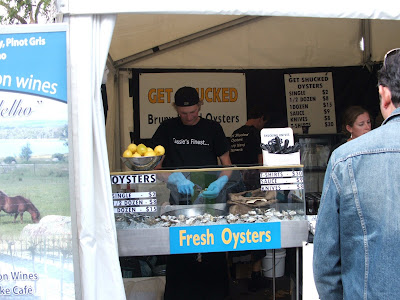
Bruny Island "Get Shucked Oyster Farm" Stall.

“He was a bold man that first ate an oyster”

(Johnathon Swift, listed as a cliché In “Polite Conversation”)


Yes, he was bold, that man, but he was also a bloody legend! If it weren't for him (or her) we'd not be able to sample these plump, lusious and, let's face it.. deeply sexual delights.


Yesterday, Furry and I trooped of to the Melbourne Slow Food Festival, and we arrived early enough that the crowds were still thin. Our first port-of -call was the Get Shucked Oyster Farm
stall from Tasmania's Bruny Island.


There was a lovely young man behing the jump shucking oysters for Africa! His knife skills rivaled Bourdain's!

Now, for those of you who are already afficionados of the raw oyster, I ask you to bear with me. For those of you who have never tasted them, here's what they are like:

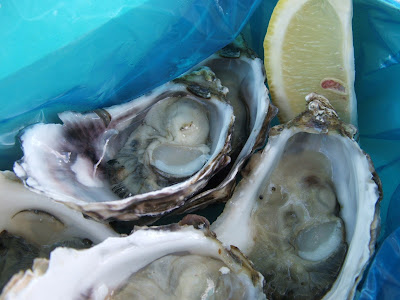
Sweet salty morsels bursting with a taste of salt wind by the beach on a summer day all wrapped up in a icy cold buttery salty fleshy plump labia.

On the half shell.

With a squeeze of lemon.


There are oysters and then there are BRUNY ISLAND oysters. And like Cold Duck Spumante and Verve Cliquot. there is a vast range of difference.


THESE are the real deal, the real McCoy.


And sitting on the banks of the Yarra, listening to the sussuration of the oars of the Wesley rowers, under the shade of an iconic Plane tree, eating these delights from their shells, pressing their plump bodies against the roof of my mouth and pretty much experiencing the ultimate taste orgasm, it was all I could do not to rip my bodice asunder and allow Furry to ravish me.


Instead, I opted for hurling back into the gathering fray and try something else.