Showing posts with label Asian. Show all posts

Friday, 18 March 2011

Char Sui Pork

You make sacrifices to live up here. You mostly live behind 9ft steel fences and razor wire, and not all the tropical frangipanis in the world can hide that fact. It's dangerous to go into town on Thursday, as it's payday and the local troublemakers are out and about.

You ALWAYS lock your car door before leaving the compound.

It's a fact that your house WILL be burgled during your tenure up here. You buy some sort of food when you see them, because you're never sure when you'll see them again.

BUT.. the upside is that everything you buy from the market is organic and local. There are no pesticides up here that are affordable for the locals. And tropical fruits and veg are so unbelievably cheap. I get mud crabs and lobster tails delivered to my door, if I choose. A local, organic pineapple costs about 20c AUD.

And if you shop right, all your meat and eggs are local and organic as well.

Sure, you can buy Zenag or Table Birds chickens, but you can also go to the market and get one slaughtered and plucked for you, right there on the spot.

And not that they slaughter pork on the spot, but depending where you get it from, it's local and effectively free-range.

I say "effectively" because there is really no concept of free-range or organic  up here. It's all just food.

So I get my pork from a farm in the Ramu Valley, where it is left to forage on whatever the jungle can provide.

I can also get cus cus meat and smoked fruit bat, but I am working up to that!

So, to dinner.

While pre-fab sauces, rubs and marinades are becoming more regular in supermarkets, it's just as easy to grab the raw ingredients.


Believe it or not, Char Sui style cooking is popular all over the Pacific Rim,a nd not just indigenous to China. Hawaii has it's own version, as does Malaysia (where you can get vegetarian chari sui, apparently)

Recipe varied from wiki cookbooks version.

Ingredients:
  • 1 kg pork shoulder, skin on
  • 2 tbsp. dark soy sauce
  • 2 tbsp. light soy sauce
  • 2 tbsp. oyster sauce
  • 2 tbsp. Shaoxing rice wine
  • 2 tbsp. clear honey
  • 4 tbsp. hoisin sauce
  • ½ tsp. five spice
  • red food colouring (I omitted this, as it's unavailable up here)
  1. Pierce the pork all over thoroughly with a fork. This makes the pork more tender and allows the marinade to penetrate the meat to give flavour all the way through.
  2. Mix all other ingredients together.
  3. Place pork  in a tray and cover with marinade. Ensure strips are covered completely in marinade.
  4. Cover tightly with cling film and place in the refrigerator for several hours. Overnight or for 24 hours is preferable.
  5. Preheat the oven to 160°C and  place the pork on a rack over  a pan in the bottom to catch drippings. Line this pan with aluminium foil to make cleaning easier
  6. Roast for 20 minutes,  Baste to build up a good layer of marinade on the outside of the meat. The pork should turn a golden-red colour as it cooks. After 20 mins, turn and baste againm giving the pork a further 20 mins at this temp.
  7. Increase heat to 220°C for a further 20 mins (total cooking time, 60 mins)
  8. If crackle hasn't crisped up, give it a few minute under the grill, to achieve that authentic charred look and flavour.  

  1. Heat leftover marinade until it becomes thick and glossy, to use as a dipping sauce.
  2. Cut pork into .5cmslices and serve on white rice with sauce/marinade. 


Thursday, 6 May 2010

A face like a bucket of Ma Po tofu.


I'm a fickle bitch. Quixotic and mercurial.

Only the other day I blogged about my latest obsession being dumplings.

No more.

My affair with dumplings was fleeting and tawdry.. based on my basest animal urges.

What is commonly called love, namely the desire of satisfying a voracious appetite with a certain quantity of delicate white human flesh. ~Henry Fielding


Now I have discovered The One. The Real Thing.

The one, at whose first tender lip brush, I hear heavenly choirs of seraphim.

Ma Po tofu.

Seriously. This is a dish so made of awesome.. from its odd translation ("old lady pockmarked face beancurd"), to the rich and hearty soupy broth, in which resides slow cooked minced pork and cubes of silken tofu, there is nothing not to love about this dish.

Wiki says:

Ma stands for "mazi" (Pinyin: mázi Traditional Chinese 麻子,) which means a person disfigured by pockmarks. Po (Chinese 婆) translates as "old woman". Hence, Ma Po is an old woman whose face was pockmarked. It is thus sometimes translated as "Pockmarked-Face Lady's Tofu". Legend says that the pock-marked old woman (má pó) was a widow who lived in the Chinese city of Chengdu. Due to her condition, her home was placed on the outskirts of the city. By coincidence, it was near a road where traders often passed. Although the rich merchants could afford to stay within the numerous inns of the prosperous city while waiting for their goods to sell, poor farmers would stay in cheaper inns scattered along the sides of roads on the outskirts of the ancient city. Another less widely accepted explanation stems from an alternate definition of 麻, meaning "numb": the Szechuan peppercorns used in the dish numb the diner's mouth.
The combination of dried birds eye chili and Szechuan peppercorns gives this dish a bite that is NOT for the faint-hearted, but you can adjust it to suit most palates. True Mapo doufu is powerfully spicy with both conventional "heat" spiciness and the characteristic "mala" (numbing spiciness) flavor of Sichuan cuisine. The feel of the particular dish is often described by cooks using seven specific Chinese adjectives: 麻 (numbing), 辣 (spicy hot), 烫 (hot temperature), 鲜 (fresh), 嫩 (tender and soft), 香 (aromatic), and 酥 (flaky). These seven characteristics are considered to be the most defining of authentic Mapo doufu.

The other benefit, if that all of that chilli increases you metabolic rate, giving you a natural chilli high, and is said by some to aid weight loss. The tofu is an awesome source of phytooestrogens.

  • Marinade for Ground Pork:
  • 1 1/2 Tbsp tapioca starch (can substitute cornstarch)
  • 2 tablespoons soy sauce
  • Other:
  • 500g pound ground pork
  • 500g pound regular tofu (medium firmness)
  • 1 leek or 3 green onions
  • 1/4 tsp salt
  • 1 tsp Chinese salted black beans (fermented black beans, also called Chinese black beans), or to taste
  • 1 Tbsp chili bean paste, or to taste
  • 3 Tbsp stock (chicken broth)
  • 1 Tbsp cornstarch
  • 2 Tbsp water
  • 2 Tbsp light soy sauce
  • Freshly ground Szechuan pepper
  • 2 - 3 tablespoons oil for stir-frying, as needed

Preparation:

Mix marinade ingredients. Marinate pork for about 20 minutes.
Cut the tofu (bean curd) into 1/2 inch (1 cm) square cubes, and blanch (drop into boiling water) for 2 - 3 minutes. Remove from boiling water and drain.
Chop leek or green onions into short lengths.
Heat wok and add oil. When oil is ready, add the marinated pork. Stir-fry pork until the color darkens. Add salt and stir. Add the salted black beans. Mash the beans with a cooking ladle until they blend in well with the meat. Add the chili paste, then the stock, bean curd, and leek or green onions.
Turn down the heat. Cook for 3 - 4 minutes.
While cooking, mix cornstarch, water, and soy sauce together. Add to wok and stir gently. Serve with freshly ground Szechuan pepper.

recipe from http://chinesefood.about.com

Wednesday, 5 May 2010

More on Furry's learning curve.


I am currently obsessed with dumplings. Gow Gees. Shui Mai. Gyoza. Wrap pretty much anything in a pastry wrapper, and I'll give it a red hot go. Coming off 5 weeks of being sick means that I have to treat my system with kid gloves. Dairy is still out, as is anything fatty. I've been living off Majick Phở and rice dishes for weeks, so I am on a major flava crava jones right now.

Furry.

Hmm. Yes.

Well.

He's back in Melbourne, longer than he expected. A few irons in the fire to get him back to PNG, but nothing set in concrete yet. We've adjusted to sharing living spaces again and I must admit, it's nice to come home and have the house all clean, and dinner cooked. In lieu of rent, I get my gutters cleaned and Furry Balls on demand.

Not such a bad arrangement, actually.

So yesterday, Furry announces he want to improve his repertoire of Furry Ball recipes. So I phaff off to work, leaving him with some $$ for ingredients and my car.

And get home to 90 dumplings, in 4 different flavours.


A quick call to friends up the hill, with an impassioned plea to come and help us eat all of the fruits of his labour, and we've got an instant Furry Ball Feast! It was so SO good, we have decided that while he's in town we'll utilize his skill and we've declared Tuesday "Dumpling Night"

This, from the man I met all those years ago, who thought serving nachos with a paint scraper was the height of his culinary possibilities. ]

Last nights offerings were chicken and ginger, pork and 5 spice, classic Furry Balls, and beef with Schezhuan pepper. The dipping sauces were siracha, red vinegar and sweet chilli, hoi sin, classic light soy and Furry's own concoction of soy, vinegar, sliced birds eye chillies and diced coriander roots.

He is now the proud owner of a mincer (for his up and coming seafood gow gee fest next Tuesday night), and is, as we speak, at home experimenting with xia long bao, or Shanghai soup dumplings.

And in true GREAT home cook style, he is realizing that a repertoire is not about how many recipes you can churn out from cookbooks, but on how you can adapt your knowledge-base to allow for seasonal ingredients, individual palates and plain old cravings.

Thursday, 23 July 2009

Asian Penicillin


Recently, Furry and I had need to have a Typhoid injection.

Man, those suckers hurt like a BIOTCH! Not the actual injection so much, but the rolling nausea and throbbing joint pain for the 24 hours afterward has made me think that actually catching typhoid might be a more pleasant option.

So for dinner that night of the injection, we turned to one of our original stand bys in time of need.

Asian Penicillin, aka noodle soup.

Take a packet of Hokkien noddles, loosen them in hot water and set aside.

Into a couple of servings of chicken stock, add a star anise, some ginger, garlic, spring onion greens and a goodly slurp of sesame oil and bring to a gently simmer.

Add some finely sliced chicken thigh meat, some Asian greens, a bit of baby corn, some mushrooms, some gow gees (if you have any) and the noodles at the last minute.

Serve in deep bowls, add a raw egg and a dash of soy, swirl all in together and eat snuggled up on the couch.

Tuesday, 18 November 2008

Noodle-y goodness

It's weird, the weather in Melbourne, at this time of year. Last Friday started out with torrential thunderstorms... poor Stella Bella Bottom Smeller and Mrs Peaches did their best jelly-dog routine. There's nothing like being woken by a clap of thunder AND a quivering dog's snout in your ear, both within milliseconds of each other, to REALLY start the day with a smile.

By the end of the day, we'd cycled through having the heater running, to nearly passing out with humidity, all the way across the spectrum into having the cooler on.

I mean, just what do you cook in weather like that??

I opted for noodles. Quick, easy... not too much time at the stove, easy to eat.. not to heavy in the stomach. Perfect on all counts.

I had a packet of rice sticks left over from last night's Yakatori Beef Salad, and a random bag of cooked and peeled prawns, so here's what I did.:

400g lean chicken mince
400g cooked and peeled prawns
2 green onions, chopped finely
2 cloves garlic, crushed
2cm piece fresh ginger (10g), grated
¼ teaspoon five-spice powder (or a mix of ground Szechuan pepper and star anise)
1 tablespoon Hoisin sauce
1 tablespoon fish sauce
2 tablespoons coarsely chopped fresh coriander
1 tablespoon coarsely chopped fresh Thai basil
1 tablespoon sesame oil


Heat the sesame oil till smoking, add the onions, garlic and ginger. Cook until softened, Add the mince and spices, and cook off until the mince is cooked thru. Add yourHoisin and fish sauces, and the prawns . Cook for 2 mins or until the prawns are heated through and add your herbs.

Cook rice sticks as per the instructions (takes about 4 mins). Drain thoroughly and add to pan. Toss a few times to combine, adding a slurp of soy if it starts to stick. (This is not a slurpy noodle dish, the end result should be quite dry)


Plate up and top with crushed peanuts or sesame seeds, and some spring onion greenery.

Monday, 10 November 2008

I am an oyster snob.


We all know a noisy noise annoys an oyster. Ok. maybe YOU don't, but I have been waiting for MONTHS to use that.

Ok.. moving right along.

**ahem**

Oysters. Up until this past holiday, I thought they were preety much like wine, or art. All the nuance was in the eye... or in this case, the mouth of the beholder. Or the eater.

Whatever.

Recently, on our trip to Merim-Bueller, we got to taste a whole range of the local seafood. Which included the local oysters. I can guarantee these were as fresh as you are ever likely to get, as we saw them harvested and shucked directly in front of us.

And sadly, I was expecting ambrosia and all I got was "Meh" **insert Jewish Bubbu shoulder shrug**

Really, the damn things didn't taste any different from the oysters I get at my suppliers back in Melbourne.

They were nice, don't get me wrong, and cheap.. $10 a doz, but they sadly left me totally underwhelmed. After the Bruny Bay oysters I tasted at last years Slow Food Fest, the difference was palpable. Rather than plump, succulent morsels bursting with briney goodness, these were just flat. Flat as in not plump in shape, or flavour. Rather than a bold whack-in-the-face taste of the sea, this was a flat, pale imitation.

A real disappointment.

However, the region's seafood rep redeemed itself with the local Eden mussels, which I had served at The Aquarium Wharf Restaurant, in Merimbula. The reverse of the above. I had seen them at the Fisherman's co-op in Eden for $11 a kg, which was rather pricey when I can get Melbourne mussels for $2 a kg in season.

Newp. These mussels are larger and fuller flavoured than my local ones. While the Merimbula oysters were flat, these mussels were plump and luscious. More so than any other mussel I've ever tried. The Wharf Restaurant served them steamed in an Asian "soup" of Tiger beer, coconut milk, galangal, coriander and chilli. This dish was a first place tie for Best Lunch of the Tour, along with the open steak sandwich at Rockpool (at the Merimbula Bowls Club!).

Not only was the food outstanding, the view from the wharf restaurant was spectacular! Our waitress was teeling us that the previous week, they'd had whales frolicking just off the restaurant, but alas, none graced us with their presence that day.

Sunday, 20 July 2008

The House of the Lurgy.

Yup. The kids have it. That's the beauty of having kids.. when you get sick, they become the gift that keeps on giving. And as I get over the lurgy from Hell, Furry's kids have come down with it. Well, actually Ya-Ya Superstar has glandular fever.. it's Els who has the lurgy. And Madame Mouse. Without putting too fine a point on it, we're the House of Snot. Of discarded tissues and Dimetapp. Of middle-of-the-night coughing fits and knocks at the bedroom door asking for Codral. No-one has slept much, and everyone is a leeetle cranky.

So I pulled out another old stand by. I am a huge fan of congee when I am sick, but the kids don't like the porridge consistency, so my other old stand by is chicken and sweetcorn soup. It goes down a sore throat nice and easy, and contains enough nourishment to sustain the sickest of kids. And it just tastes bloody good, too!


(I know this looks a little like something you'd find INSIDE a used tissue, but a close-up of the end texture is important!)


pg's Asian Penicillin.

soak 3 ears of corn (leaving on the husks) in cold water for 30 minutes. Remove a couple of the outer husks and set aside. Peel the rest of the husks back and remove the silks. Re-wrap the corn in the husks and use the discarded ones to tie a knot in the top of the husks. Roast, steam or grill for 30 mins until cooked.

Remove the corn kernels.

Roast a whole chook. Don't get too fancy.. it's ending up in soup. I just stuff the cavity with a couple of orange halves to impart a flavour and keep it moist. Set aside until cool enough to touch. Remove all the meat and skin from the carcass. Roughly chop meat and skin.

Into a large pot place 2-3 litres of water. Dice an onion or leek and place into the water, along with a good knob of ginger, a star anise some Chinese cooking wine (or dry sherry), a couple of Schezhuan peppercorns, the chicken and the sweetcorn. Add a goodly slurp of light soy.

Simmer for about 2 hours, or until the chicken flesh breaks down into individual fibres.

Remove the knob of ginger and the star anise.

Make an egg flower by mixing 3 eggs in a bowl with a splash of light soy and a couple of drops of sesame oil. Turn the soup off the heat, give it a swirl and slowly dribble the egg mix in.

(another trick is to add a can of creamed sweet corn at this point, which further thickens the soup)

Serve with soft bread sticks, or slurpy noodles, and you've got the cure-all for the lurgy.

Friday, 11 July 2008

Char Kway Teoh.

Char Kway Teoh is a classic Singaporean Hawker dish. There are as many variations of this as there are noodles in a serve. I've seen ones with oysters rather than chicken. It's a dry noodle dish, you want to sauce only to coat and adhere to the ingredients, it's not a "saucey" dish, I particularly like the little bits of char that adhere to the noodles, when you cook them at this higher temp. We had some bits of red capsicum left over from the night before, so I added them as well.

I'd wax on more lyrically about it, except Blogger.. or maybe Mozilla is in a mood today, and I've lost and reclaimed this post three times now.

Best I hit "publish" before the Moofies strike again.

Char Kway Teoh.

500g kway teow (fresh flat rice noodles)
2 cloves garlic finely chopped
a handful of fresh bean sprouts
2 baby bok choys, cut into strips
1 Chinese sausages, thinly sliced
8 medium sized prawns, (fresh is best, pre-cooked if you have to)
1 onion cut into strips
1 chicken breast, steamed and cut into strips
2 eggs, beaten
2tbsp fish sauce
3 tbsp sweet dark soya sauce (Kejap Manis)
1 tbsp sambal chilli paste (or Sambal Oelek)

Heat a large wok until very hot. Add a splash of cooking oil (I used peanut for this dish) and fry garlic until fragrant. Add kway teow, onions, chicken, prawns and fry, stirring constantly for about two minutes. Push the ingredients to the side of the wok, forming a well in the centre. Add the beaten egg, allowing it to set slightly before mixing it with the noodles. Add the Sambal Oelek, the bok choy, the fish sauce and sweet dark soya sauce and fry all ingredients together for another one to two minutes before adding the Chinese sausages and the bean sprouts. Toss to combine. Serve hot.

Tuesday, 3 June 2008

Evolution.

My husband, Furry. He is living proof that a leopard, if willing, CAN change its spots. When I met him.. and I mean on those first few dates when you're kinda checking out a potential mate, he nearly got flicked. Call me shallow, but as a food obsessive, it was really important to me to meet someone who was as "into" food as I was. And guys? If you're reading this, what you are about to learn is a pretty important piece of "secret girl business". All women (and maybe some guys) have a secret list... it's divided into "can do's" "could do's" and "deal breakers". My list looked something like this:

Must be gainfully employed. (deal breaker)
Must have chest hair (can do))
Must have resolved issues with any ex (deal breaker)
Must love to eat and cook (deal breaker)
Must have an interest in gardening (can do)
Must love the water (could do)

I am sure you get the idea. So, on those first few dates, I was marking off the mental check list, determined not to be swayed by the luscious broad shoulders and the kindly manner. Our tastes in music were a "could do". He's into trashy heavy metal and I am a classical girl. He is a total sports nuts, while I'd rather read a book. (can do) His politics and mine were gulfs apart (could do).

And then I asked one of my deal breaker questions. And this is how the conversation went.

pg: So, what sort of foods do you like?
Fur: Umm.. I dunno.. I like Chinese.
pg: What sort of Chinese? Hunan? Szechwan? Cantonese?
Fur: Ummm.. I like lemon chicken and beef in black bean.
pg mentally enters an X on her mental check list
pg: What about Thai? Do you like Thai
Fur: Ummm.. I dunno, never eaten it.
pg: What about Vietnamese food?
Fur: Don't they eat cats?
pg mentally enters a double XX on her mental check list
pg: What about Japanese? Ever eaten Japanese?
Fur: **insert look of incredulous horror on Furry's face**
Raw fish? No freakin' way, I would NEVER eat that shit!!

Well, it's bloody lucky for Furry that I was mesmerized by his broad shoulders and his kindly, almost 1950's manner, because I gave him three weeks. I referred of him, to my girlfriends as my "disposable chew toy"

Fast forward to about a year later. Furry comes home in a dark-assed mood. Why? Because his new job is somewhere where he can't get any decent sushi for lunch. It's okay tho, because there is a Viet bakery selling banh mi, and that will do.

He's a work in progress, my lad!

After the Second Big Heart Attack of 2005, Furry decided to get into cooking. He does a mean turn in "bachelor" food.. wraps, nachos, spag bog, but he decided to get into cooking "the way YOU do"

So far he's mastered, gow gees, lime glazed pork spare ribs, seafood rissoni, banana fritters, rice paper wraps, Nam Jim chicken, san choi bow and much MUCH more.

He even owns about 7 cook books.

And last night, I saw his final stage of evolution from bogan boy, to GREAT cook. Up until now he has been religiously following recipes.. measuring and weighing ingredients, and following the recipe slavishly.

Last night we had:

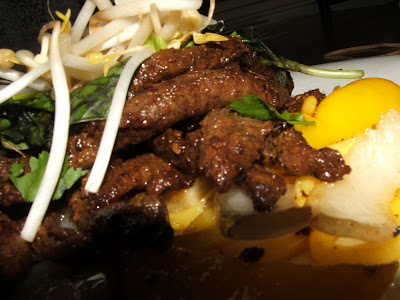
Korean Marinated Beef Strips
(adapted by Furry, from The Hinkler Kitchen "Wok Perfection" cook book)

500g of lean beef, cut into strips
(he used my newly sharpened cook's knife to do it himself, rather than buy pre-fab strips)
2 spring onions chopped
(He sliced them in his very own V-Slicer)

Marinade
2 tablespoons sesame seeds
2 cloves garlic finely chopped
2 1/2cm piece of fresh ginger root finely chopped
2 tablespoons palm sugar
(purchased by Himself at his sown secret Asian Food store)
3 tablespoons light soy
3 tablespoons dark soy
(yes, he now DOES know the difference)
1 tablespoon sesame oil.

Method.
Dry fry the sesame seeds till golden, Place in a mortar and pestle with all other marinade ingredients and grind until a thick paste is achieved. Pour over beef strips, add 1/2 the chopped spring onions and marinate in the 'fridge for at least 4 hours.
Cook in a smoking wok, in batches until done.


The recipe says to serve on rice, or with Hokkien noodles, but here's Furry's take on it.

Red Bean Stir Fry
(adapted by Furry, from The Hinkler Kitchen "Wok Perfection" cook book)

185g of fettuccine cooked till al dente and set aside,
1 tablespoon vegetable oil
1 onion chopped
2 cloves garlic, crushed
250g asparagus cut into 5cm lengths
125g fresh green beans
125g fresh yellow beans
440g can red kidney bean, drained and rinsed
2 tablespoons chopped fresh coriander
90g pine nuts, toasted.
fresh bean sprouts to garnish.
Heat oil in wok, add onions and garlic and fry till onion is golden. Add all the fresh vegetables and quickly fry off until tender, but still retain some crunch. Add red kidney beans, coriander and fettuccine and heat through (about 3 mins). Scatter with pine nuts, top with Korean Beef Strips and garnish with bean sprouts.

And bugger me backwards with a spoon, if he didn't even take the bloody photos, too!!

Sunday, 18 May 2008

Steamboat Willie!!


Hmmm.. given this is a food obsessives blog, read (presumably) by other food obsessives, the title of this post conjures up images of Helen Mirren in The Cook The Thief His Wife & Her Lover.

Sorry 'bout that.

Last night I got to christen my Mother's Day present. My new steamboat (Thanks, Mousie!). These things are available at most Asian grocers and come with little wire baskets for cooking/retrieving the food. Given that I recently talked to Ed from Tomatom about what I had in my kitchen, I have, in one Mother's day, gone from being a bit of a purist and only owning 2 decent pots, a heavy duty dutch oven, a single set of German cook's knives, a Le Crueset-style casserole pot and a Mull-O-Matic, I am now the proud owner of a steamboat (and accessories) and an ice-cream maker!

Alos, make sure you have a hunking great big plank of wood (we had some off-cuts of oregon under the house) to put your Steamboat Willie on. These things conduct heat like Stokowski doing the 1812*.


We sourced some local flake, the last of this season's mussels


Some frozen Aussie (SA) prawns, some local scallops , and Furry got all unnecessary about something called "Lobster Balls" (insert naughty pre-teen boy snicker)


Which turned out to be made from that nasty seafood extender that I eschew. He declared them lovely, tho.


Some fresh fillet steak cut into strips and some La Ionica chicken, done the same. Add a bowl of local mushies and some bok choi from the local greengrocers.


Into your steamboat, whack about a litre of good quality chicken stock. I was going to flavour mine with star anise and lemon grass, but then decided the whole idea of this dish is to let the ingredients flavour the stock. Food is put in the reservoir and hot coals whacked down the spout (we used heat beads, prepared to glowing over the gas ring). The ideas is that people can pick and choose what they want to cook, and for how long, and the morsels are them picked out with wire baskets, transferred to your bowl and a variety of dipping sauces are used to further flavour the goodies. This time I had a selection of Hoi Sin, terryaki, oyster sauce, and Furry's fantastic Nam Jim sauce.

2 cloves garlic, crushed
1 large green chillie, chopped
2 coriander roots
2 tablespoons fish sauce
2 tablespoons grated palm sugar
3 shallots (75g), chopped
¼ cup (60ml) lime juice

Combine all above ingredients and set aside

(adapted from the Women's Weekly Low Fat Cook Book)

The idea is that after all the ingredients are eaten, you add mung bean noodles to the soup, let them cook off, and then ladle the noodles and the soup into the bowls, add more sauces if you so desire, and drink the noodly broth. However, by the time we finished this lot, there was no room for slurpy noodly goodness, so we strained the broth, put aside the noodles and will have them tonight.

Every home should have a Steamboat Willie!

Obscure Classic Music Footnote: * Stokowski was the conductor that featured in Disney's "Fantasia" and was the conductor that the famous Bugs Bunny "Long Haired Hare" conductor cartoon was based on.


Thursday, 15 May 2008

"'The time has come!', the Walrus said..."

“O, Oysters, come and walk with us!”

The Walrus did beseech.
“A pleasant walk, a pleasant talk,
Along the briny beach:
We cannot do with more than four,
To give a hand to each.”

The eldest Oyster looked at him,oyster
But never a word he said:
The eldest Oyster winked his eye,
And shook his heavy head—
Meaning to say he did not choose
To leave the oyster-bed.

But four young Oysters hurried up,
All eager for the treat:
Their coats were brushed, their faces washed,
Their shoes were clean and neat-
And this was odd, because, you know,
They hadn’t any feet.

(From "The Walrus and the Carpenter", Lewis Carroll)


Oysters natural, freshly shucked and served with lemon
from
Ceduna oysters,
from Oysters aRe Us,
2/3 Dunlop Road,
Mulgrave,
ph: 9545 1333


Further to our newly established "date night" with our friends Joon and George, last night George warily acceded to Furry's request for 4 doz oysters. No, that's NOT a typo. FOUR. DOZEN. OYSTERS.

It's not so bad when you break it down and realise that it's only a doz each.

Just a snack, really.

I put up a shout out over at Chowhound, and got some really good ideas. . Broiled Oyster with Arugula Puree and Champagne Sabayon, Oysters Bienville, and many votes for simply au natural.

My ideas were pooh-poohed by my guests... it's traditional they wanted, so traditional they got.


Oysters done Mornay style. Meredith Dairy marinated goats cheese used.


And again...


pg's oysters with an Asian twist. freshly shucked Ceduna oysters, with terryaki, lime juice and crispy fried shallots.


The classic Oysters Kilpatrick

My fave? Surprisingly, the mornay. It's been about 20 years since I had an oyster mornay, but I think the use of the marinated goats cheese lifted it from the boring 80's dish I remember, to something creamy and sublime. Least fave? The Asian twist. I think I was a bit heavy handed with the terryaki sauce and it overpowered the delicacy of the oyster. The fried shallots were a nice textural component, though. I'd do it again with more lime, less terryaki next time. Furry is off to the supplier to find out more today... ask those pesky SOLE questions and all of that. I will report back what he finds! Stand by for next week's Date Night.

Thursday, 24 April 2008

Australian Food?


I am often asked on other food forums "What is "typical" Australian food?".. and at first thought, I am always tempted to say meat pies, lamingtons and Vegemite. But the reality is that Australian food is so SO much broader than that. Historically, Australian food prior to the 50's was linked back to England. Australia was culinary, politically, spiritually, socially tied to King and Country. Our collective subconscious was Mother England all the way.

In the 50's, with the post-war immigration boom, and more importantly, the Snowy River Project,
The workers and their families

More than 100,000 people from over thirty countries came to the mountains to work on the project. Up to 7,300 workers would provide their labour at any one time.

Seventy per cent of all the workers were migrants. They came to Australia to work on the project, attracted by the relatively high wages. At that time, soon after the Second World War, work was hard to come by in Europe.

At first, most of the workers were men who had left their families at home in Europe. Their plan was to work hard, save money and bring their families out when they could afford to.

The work was hard and the conditions were tough. Because ninety-eight per cent of the project was underground, there was a lot of tunnelling, often through solid granite rock. Work in the tunnels was dirty, wet, noisy, smelly and sometimes dangerous. More than 120 workers died in the project's twenty-five year period.

Living conditions were also hard in the camps and towns built in the mountains to house the workers and their families. Often these dwellings were not suited to the freezing conditions. They were cold and the water would freeze in the pipes. When the workers' wives came to join them in the townships, these women had to work hard to overcome the hardships and establish communities in the strange, new, wilderness environment. When work in one area was completed, the dwellings were dismantled and moved to another area, so very little remains of these towns today.

The majority of the workers stayed on to live in Australia after the project was completed, making a valuable contribution to Australia's modern multicultural society

.

(from "Snowy Mountain Scheme: Australia's Cultural Portal")

From 1949 until 1974, Australia saw an influx of new cultures, new ideas and more importantly, new food.

The blonde, blue eyed migrants assimilated, but the Greeks, the Italians, the Turks all suffered at the hands of the White Australia Policy (itself a result of interracial tension between "Australian" and Chinese migrants in the 1850's. It was all well and good to have those "dirty wops" digging our power scheme, but to actually have them living here???

The White Australia policy is a term used to describe a collection of historical legislation and policies that intentionally restricted non-white immigration to Australia from 1901 to 1973.

The inauguration of White Australia as government policy is generally taken to be the passage of the Immigration Restriction Act in 1901, one of the first Acts of the new national parliament upon federation. The policy was dismantled in stages by successive governments after the conclusion of World War II, with the encouragement of first non-British and later non-white immigration. From 1973 on, the White Australia policy was for all practical purposes defunct, and in 1975 the Australian government passed the Racial Discrimination Act, which made racially-based selection criteria illegal.


(from Wiki)

It's a testament to the ingenuity and tenacity of non-white migrants, that they actually stayed, suvived and went on the thrive. And in doing so, sowed the seeds for the insanely multicultural food that is now available to us. Can you imagine Melbourne take-away without a souvki? The Manly Corso without a falafel bar?


Preceding this of course, was the indentured labour of the Chinsese migrants during the Victorian Gold Rush and the Kanak workers for sugar cane in Queensland. In Melbourne, the Chinese population survived in small, cloistered, insular ghettos in central Melbourne.

Arthur Caldwell, himself the son on Irish immigrants, uttered his infamous "Two Wongs Don't make a White" in 1947. (This quote, taken out of context, was to become the catch cry of the White Australia Policy WELL into my youth)

The arrival of Vietnamese "boat people" in the 70's and 80's saw yet another round of immigration and racism, which today translates as most Australians knowing what pho and banh mi are.

The history of Australian cuisine is the history of Australia's adolescence, the history of defining itself (ourselves?) as something separate from our "Mother" (Country). It's the history of racism. From exploitation to negation, to marginalisation to grudging acceptance and finally into mainstream society, ethnic groups in Australia have all held on to one thing. Their cuisine. And in doing so, have made "Aussie food" as varied as the iconic pie (thought to have been brought to Australia by *duh* MIGRANTS!) to Chili Crab, from the pav to Mongolian Beef.

The latest migrants to be vilified are the Somali's, but I hold out hope of mufo and baasto gelling into the Australian food psyche

And it's only very recently that Bush Tucker (traditional aboriginal food) has become mainstream. (But that's a WHOLE 'nother post!)

So, with all of this in mind, we FINALLY come to last night's dinner.

Mongolian Beef.

dry fry 1/3 cup of sesame seed until golden. Place in a mortar and grind with garlic and ginger. Add 3 chopped spring onions, 2 tablespoons of both dark and light soy and a tablespoon of sesame oil. Mix to a paste.

Take 500g of beef strips and marinate in this mix for a couple of hours. Fry off in a wok and serve on rice.

EXCEPT... (and here's where all of this rambling post comes together, folks!), because of the culinary history of Australia, here's what Furry and I did:

Make the beef up as above, serve with Hokkien (Chinese) noodles, wok-fried with onion and yellow caps (Generic Asian). Serve sprinkled with bean sprouts (Vietnamese) and hand-torn basil and coriander (Thai)


And had Blue Ribbon Vanilla Ice cream with chocolate sauce from Daylesford for sweetie!!

Australian Fusion Food at its finest!!